

Pressure-Assist vs Gravity Flush Toilets: Which Is Better?
Posted by Admin on Nov 10th 2026
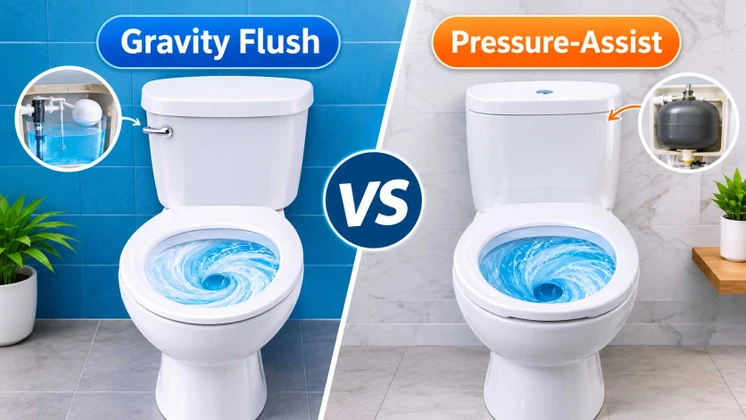
Pressure-assist toilets flush with more force and clog less often, but they cost more, flush louder and need specialized parts. Gravity toilets are quieter, cheaper and easier to repair, and today's high-efficiency designs handle everyday use well. For most homes, gravity is the better default. Choose pressure-assist when clogs keep coming back or your drain line is long or gently sloped.
If you have searched for a "power flush toilet," you are probably weighing these two flushing systems. This guide explains how each one works, where each one wins, and how to read the specs so you buy the right toilet the first time.
How does a gravity flush toilet work?
A gravity toilet stores water in an open tank. When you flush, the water drops through the flush valve into the bowl, and the rush of water starts a siphon that pulls waste through the trapway and into the drain.
It is a simple design with few moving parts, which is why gravity toilets dominate the residential market. Performance still varies a lot from model to model. Bowl shape, trapway size, rim jets and flush valve design all change how well a gravity toilet clears the bowl, even when two models use the same amount of water.
How does a pressure-assist toilet work?
A pressure-assist toilet hides a sealed plastic vessel inside the porcelain tank. After a flush, the vessel refills using your home's water supply pressure, which compresses the air trapped inside it. On the next flush, that stored pressure releases and drives water into the bowl much harder than gravity alone.
Because the water sits inside the vessel instead of an open tank, the porcelain tank stays dry on the outside and does not sweat. You have probably used one already, since pressure-assist toilets are common in public restrooms.
The pressure vessel, often a Sloan Flushmate unit, is built into the toilet. It cannot be added to a standard gravity toilet later.
Pressure-assist vs gravity: side-by-side
|
Feature |
Gravity flush |
Pressure-assist |
|
Flush force |
Good to excellent, depending on the design |
Stronger, jet-like flush |
|
Clog resistance |
Varies by model |
Fewer clogs on average |
|
Noise |
Quieter |
Louder |
|
Water use |
1.28 gpf is common; dual-flush options |
1.6 gpf down to about 1.0 gpf on some models |
|
Price |
Lower |
Higher |
|
Repairs |
Simple, parts widely available |
Often needs a plumber and brand-specific parts |
|
Tank condensation |
Can sweat unless insulated |
Tank typically stays dry |
|
Style choices |
Very wide |
Narrower |
|
Retrofit |
Standard parts fit |
Cannot be retrofitted into a gravity toilet |
Pros and cons of pressure-assist toilets
Pros
- More flushing power, which helps with solid waste and reduces clogging
- A cleaner bowl after each flush
- No tank sweating, which helps in humid bathrooms
- Water-efficient models are available
Cons
- Higher price than most gravity toilets
- A noticeably louder flush
- Repairs usually mean a qualified plumber and ordered parts
- Fewer styles, colors and configurations to choose from
Pros and cons of gravity toilets
Pros
- Quieter operation, which suits bathrooms near bedrooms
- Lower price and the widest selection of styles, heights and finishes
- Easy repairs with parts you can find almost anywhere
- Strong modern designs: Consumer Reports notes that many gravity toilets match the best pressure-assist models
Cons
- Clog resistance depends heavily on the specific model
- Tanks can sweat in humid rooms
- Budget models may need a second flush more often with heavy use
Which one is right for your home?
Choose pressure-assist if:
- Clogs keep happening, especially on a long or low-slope drain line
- A busy household or rental puts heavy daily use on the toilet
- You want the bowl to stay cleaner between brushings
- You accept a louder flush and plan to use a plumber for service
Choose gravity if:
- The bathroom sits next to a bedroom or nursery
- You prefer to handle simple repairs yourself
- You want options like one-piece, skirted, comfort-height or dual-flush designs
- You are working to a budget
Remember that pressure-assist relies on your home's water supply pressure. Check the manufacturer's requirements before you buy, and ask a plumber if your pressure runs low.
What does Power Flush actually mean?
Shoppers often use power flush as shorthand for pressure-assist, but the label is used loosely. Many gravity toilets use "power" in their names too. American Standard's Cadet 3 has a PowerWash rim, and Crown describes its dual-flush models as having a powerful flush with a cyclonic action.
Two quick checks tell you what you are really buying:
- Look for the mechanism. A true pressure-assist toilet lists "pressure-assist," a flushometer tank or a vessel brand such as Sloan Flushmate in its specs.
- Do not confuse dual flush with pressure-assist. Dual flush offers two water volumes. A toilet can be dual-flush and either gravity or pressure-assist.
Tankless smart toilets are a different category again. Our guide to smart vs traditional toilets covers them in detail.
How to compare flush performance: gpf and MaP
Two numbers matter more than any marketing name:
- GPF (gallons per flush): the water used per flush. The federal standard is 1.6 gpf, and the EPA's WaterSense label requires 1.28 gpf or less. That means a 1.6 gpf toilet cannot carry the WaterSense label.
- MaP score: the grams of solid waste a toilet removes in a single flush. WaterSense requires at least 350 grams. Some high-performing toilets score far above that.
A high MaP score gives you a safety margin, not a necessity. Most real-world loads fall well under 350 grams, so any toilet with a solid MaP score and a good trapway should serve you well.
Pressure-assist toilets we carry
We stock two pressure-assist models:
- The Ultra Flush Pressure-Assist Elongated Two-Piece Toilet uses a Sloan Flushmate pressure vessel, a 3-inch trapway and a non-sweating insulated tank. The product page lists a MaP rating of 1,250 grams and a 1.6 gpf flush.
- The American Standard Yorkville Two-Piece Pressure-Assist Toilet pairs a pressure-assisted siphon jet with an elongated bowl and an EverClean antimicrobial surface.
Important: both toilets are back-outlet designs. Waste leaves through the wall behind the toilet instead of through the floor. They fit only where your drain exits through the rear wall, and most homes use a floor drain. Measure your drain height and confirm the outlet type before you order. Both toilets also ship without a seat, and the Yorkville weighs about 110 pounds.
Not sure what your drain needs? Call our showroom at 561-360-2219 and we will help you check.
High-performance gravity toilets we carry
If pressure-assist is more than your bathroom needs, these gravity lines bring strong flushing without the noise:
- Kohler: the Memoirs Stately uses Class Five flush technology, and the Corbelle uses Revolution 360 swirl flushing. Browse the full Kohler toilet collection.
- Toto: The Drake features Tornado Flush, and the Aquia IV pairs DynaMax Tornado Flush with dual-flush water savings. See our Toto toilets, or read why Toto suits modern eco-friendly homes.
- American Standard: The Champion PRO and Cadet 3 lines are in our American Standard toilets collection.
- Crown: dual-flush models like the Nuevo are in our Crown toilets collection.
- ProFlo: value-priced two-piece models are in our ProFlo toilets collection.
Watching your budget? Check our current toilet deals.
Installation and Upkeep Tips
- Confirm the drain type, rough-in distance and seat before you order. Both of our pressure-assist toilets are sold without a seat.
- Gravity toilets use common parts such as flappers and fill valves, so many repairs are simple DIY jobs.
- Pressure-assist vessels are brand-specific, so match any replacement to the toilet's model number and leave vessel service to a qualified plumber.
- Heavy two-piece toilets are awkward to carry, so plan for a second person on installation day.
Frequently asked questions
Are pressure-assist toilets better than gravity toilets?
They flush with more force and clog less often, but they are louder, cost more and are harder to repair. For most homes a good gravity toilet is the better value. Pressure-assist makes sense when you face recurring clogs or a difficult drain line.
Are pressure-assist toilets loud?
Yes. The flush is noticeably louder than a gravity flush because stored pressure releases the water all at once. If the bathroom shares a wall with a bedroom, gravity is usually the more comfortable choice.
Do pressure-assist toilets save water?
They can. Some pressure-assist models use about 1.0 to 1.1 gpf. Others, like a 1.6 gpf unit, use more than a WaterSense toilet allows. Check the gpf on the spec sheet for the exact model.
Can I convert my gravity toilet to pressure-assist?
No. The pressure vessel cannot be fitted into a standard gravity toilet. You need a toilet built for pressure-assist from the start.
Do pressure-assist toilets need high water pressure?
They use your home's supply pressure to charge the vessel, so the manufacturer's minimum pressure requirement matters. Check it before you buy and ask a plumber if your pressure is low.
What is a power flush toilet?
"Power flush" usually means pressure-assist in everyday searches, but manufacturers also use "power" for strong gravity designs. Read the spec sheet for the words "pressure-assist" or a vessel brand such as Flushmate.
Find the right flush for your bathroom
The right choice comes down to noise, maintenance and the drain you already have. Browse all our toilets, or call 561-360-2219 for help matching a toilet to your bathroom. We ship nationwide.